



Imagine a magical box capable of generating the objects you love most—from model rockets to everyday items.
This box actually exists: it’s a 3D printer, and the magic is called prototyping. But how does 3D printing actually work?
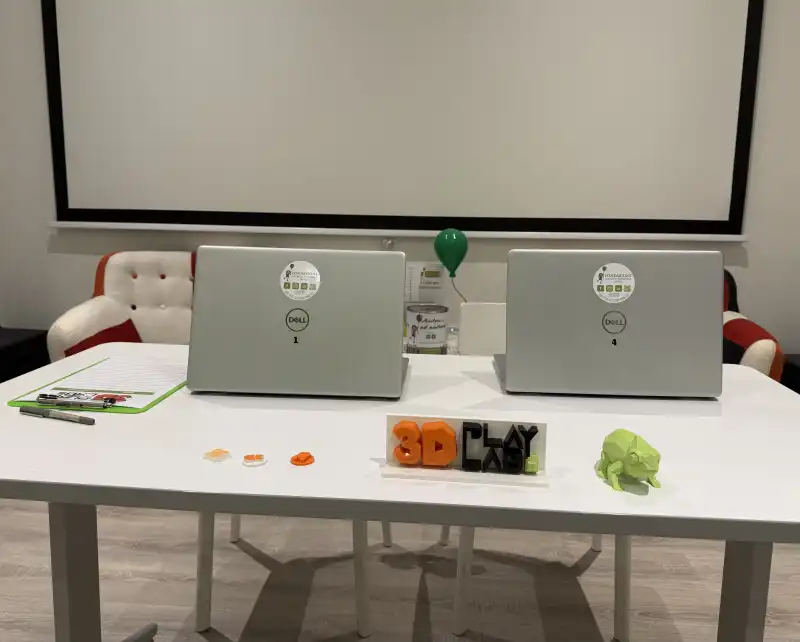
In printers using Fused Filament Fabrication (FFF) or Fused Deposition Modeling (FDM) technology, a polymer filament enters an extruder that heats the material until it becomes soft enough, depositing a small amount onto a print bed. Proceeding one layer at a time, the printer thus gives shape to the object. Recognizing the increasing widespread adoption of this technology across numerous fields, the Lucrezia Tangorra Foundation decided to invest in a Bambu Lab P1S printer and leverage its educational potential by creating the 3D PlayLab. During the first edition, participants were able to approach the world of making and 3D printing through a learning by doing approach. The young participants experienced this almost magical technology firsthand—from the initial design of the object to the actual printing using the Foundation’s 3D printer. Each participant was provided with a PC equipped with all necessary software and introduced to the world of 3D modeling. Once familiar with the tools, they were divided into groups and challenged to put their creativity and newly acquired skills to the test. Specifically, the teams competed in designing and creating first a desktop phone holder and then a customized chessboard, while adhering to a set of predefined requirements. During the final session, after a fiercely contested tournament played on the chessboards created through their own hard work, all participants received their maker certificate.
The 3D printer has proven to be an indispensable tool both for educational activities and for creating a wide variety of objects in support of the Foundation’s other initiatives. The second edition of the 3D PlayLab will launch in October, and the volunteers are ready to welcome a new group of aspiring makers.
